
Introduction
Architecture has long been used to represent political authority, national identity, and institutional power. Yet contemporary civic architecture increasingly attempts to redefine the relationship between the state and the public through ideas of openness, participation, and transparency. The Reichstag renovation by Foster + Partners in Berlin demonstrates how architecture can symbolically transform political space while also reshaping public experience.[1]
Originally constructed in 1894 and heavily damaged throughout the twentieth century, the Reichstag became a powerful symbol of Germany’s political history. Following reunification, the building was redesigned by Foster + Partners to accommodate the new German parliament while simultaneously projecting democratic openness and collective accountability.[2]
Nation, State, and Architectural Representation
In “Rethinking the Nation,” Abidin Kusno discusses the distinction between the “nation” and the “state,” arguing that architecture often operates as a medium through which political power represents itself.[3] However, Kusno also suggests that architecture can move beyond authoritarian symbolism by creating spaces that engage collective identity and public participation rather than merely reinforcing state control.
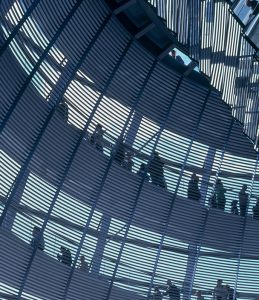
The Reichstag reflects this tension between institutional authority and civic accessibility. While the building houses the German parliament, its most recognizable architectural feature is the public glass dome positioned directly above the parliamentary chamber. Visitors move through ascending ramps that overlook political activity below, reversing the traditional separation between government and citizens.[1]
Transparency and Democratic Space
The glass dome serves both symbolic and spatial functions. Transparency becomes an architectural strategy that communicates accountability and openness within democratic governance. Rather than concealing political processes behind monumental walls, the project visually exposes them to public observation.[2]
This relationship between visibility and power shapes the building’s experience. Citizens are no longer positioned outside political space as distant spectators. Instead, the architecture allows the public to physically occupy a privileged position overlooking the parliament itself. Through circulation, visibility, and movement, Foster + Partners redefine the parliament building as a participatory civic environment rather than a closed governmental monument.[1]
Monumentality and Contemporary Identity
Although the Reichstag maintains its historical stone façade, the insertion of the contemporary glass dome introduces a deliberate contrast between permanence and transformation. The project preserves traces of Germany’s political history while simultaneously projecting a renewed democratic identity.[2]
This combination of historical continuity and modern intervention reflects broader contemporary architectural approaches toward adaptive reuse and civic symbolism. Rather than erasing history, the project incorporates it into a new political narrative centered around openness, accessibility, and collective memory.[3]
Architecture as Civic Experience
Beyond its political symbolism, the Reichstag serves as a public urban destination integrated into Berlin’s cultural life. The dome functions not only as a viewing platform but also as a spatial experience that attracts visitors, encourages movement, and connects architecture with everyday civic activity.[1]
In this way, the project challenges the idea that governmental buildings must remain distant or inaccessible. Instead, architecture becomes a mediator between institutional authority and public life, transforming political space into a shared civic experience.[2]
Conclusion
The Reichstag renovation demonstrates how architecture can redefine the relationship between political institutions and the public through transparency, movement, and collective participation. By combining historical preservation with contemporary intervention, Foster + Partners transformed the parliament building into both a national symbol and an active civic space.[1]
More importantly, the project illustrates how architecture can move beyond representing state power alone and instead participate in constructing a more open and participatory public identity.[3]
References
[1] “Foster + Partners.” n.d. Www.fosterandpartners.com. https://www.fosterandpartners.com/projects/reichstag-new-german-parliament.
[2] Frampton, Kenneth. 2007. Modern Architecture : A Critical History. London: Thames & Hudson.
[3] C. Greig Crysler, Stephen Cairns, and Hilde Heynen. 2012. The SAGE Handbook of Architectural Theory. SAGE.