
Introduction
Contemporary urban theory increasingly critiques the fragmented and segregated structure of modern cities. Functional zoning, privatized developments, and automobile-oriented planning have weakened many forms of spontaneous public interaction. In response, theorists such as Paola Viganò argue for more porous and connective urban systems that support coexistence, multiplicity, and collective urban life.[1]
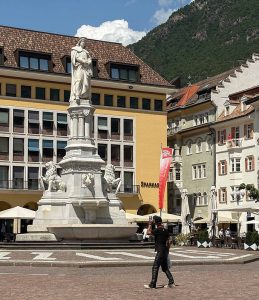
This idea becomes especially visible in Italian piazzas, where public space operates not simply as circulation space but as social infrastructure. During my time studying European urbanism, I became increasingly interested in how these urban nodes support everyday social rhythms. In many Italian cities, people gather in plazas almost instinctively. Conversations, performances, dining, music, and informal encounters emerge naturally without centralized organization or formal invitation. The piazza becomes an extension of collective daily life rather than a programmed event space.
Fragmented Cities vs. Collective Urban Space
Paola Viganò describes the contemporary city as a fragmented urban territory composed of disconnected enclaves, infrastructures, and isolated sectors.[1] In this condition, public life becomes increasingly compartmentalized. However, spaces such as piazzas resist this fragmentation because they operate as connective social fields between different groups, activities, and rhythms of urban life.
This condition closely relates to Henri Lefebvre’s concept of differential space, where urban environments support diversity, spontaneity, and lived social experience rather than rigid functional control.[1] The Italian piazza demonstrates how architecture and urban form can enable coexistence without imposing strict hierarchy or separation.
What makes these spaces particularly successful is not monumentality alone, but their capacity to sustain repeated collective occupation over time. The surrounding cafés, walkable streets, mixed-use edges, and permeability between public and private life continuously reinvigorate the square’s social energy.
Public Space as Living Infrastructure
Norman Foster emphasizes that successful cities depend on pedestrian-friendly public spaces, mixed-use neighborhoods, and social connectivity rather than isolated urban expansion.[2] Similarly, Teddy Cruz argues that meaningful urban life often emerges from bottom-up social interaction rather than purely top-down planning.[3]
Italian piazzas embody these principles through their adaptability and openness. They function as flexible civic stages where social interaction continuously reshapes the meaning of the space itself. Rather than operating as static architectural objects, these squares become living infrastructures for community formation.
Rahul Mehrotra’s discussion of temporary urbanism also reinforces this idea by showing how cities can support changing forms of occupation, gathering, and collective participation over time.[4] In this sense, the piazza is not merely a designed object but a framework for evolving social rhythms.
Conclusion
The most valuable lesson from Italian piazzas is that successful urbanism is not only about buildings or visual composition. It is about creating spatial conditions that allow collective life to emerge naturally. These urban nodes demonstrate how architecture can support coexistence, spontaneity, and shared civic identity within increasingly fragmented contemporary cities.
Rather than treating public space as a leftover circulation area, contemporary urban design should reconsider the piazza as a social condenser capable of reconnecting fragmented urban life through everyday human interaction.
References
[1] Viganò, Paola. “The Contemporary European Urban Project: Archipelago City, Diffuse City and Reverse City.” In The SAGE Handbook of Architectural Theory, edited by C. Greig Crysler, Stephen Cairns, and Hilde Heynen, 657–670. London: SAGE Publications, 2012.
[2] Foster, Norman. UNECE Regional Action Plan 2030 on Housing. United Nations presentation transcript.
[3] Cruz, Teddy. How Architectural Innovations Migrate Across Borders. TED Talk transcript.
[4] Mehrotra, Rahul. The Architectural Wonder of Impermanent Cities. TED Talk transcript.
[5]Top, Petra. 2025. “12 Magical Hours in Bolzano.” Travel Buddies Lifestyle Blog. July 14, 2025. https://travelbuddieslifestyle.com/12-magical-hours-in-bolzano/.