
Introduction
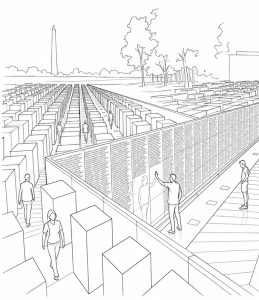
Memorial architecture is often associated with permanence, symbolism, and national identity. However, contemporary memorials increasingly challenge traditional monumentality by focusing on emotional and spatial experience rather than heroic representation. Maya Lin’s Vietnam Veterans Memorial and Peter Eisenman’s Memorial to the Murdered Jews of Europe demonstrate two radically different approaches to collective memory. While both reject conventional statues and nationalist imagery, they construct remembrance through entirely different relationships to site, movement, identity, nature, and psychological experience.
Memory Through Intimacy: Maya Lin’s Vietnam Veterans Memorial
Maya Lin’s memorial creates an intensely personal encounter with loss. Located within a quieter landscape condition in Washington, D.C., the memorial requires intentional visitation. The visitor leaves behind the city’s rhythm, walks through the landscape, and gradually descends into the earth before confronting the names of the dead directly.
Lin described the memorial not as a wall, but as “a cut into the earth.” This idea fundamentally changes how the project operates architecturally. Rather than inserting an object into the landscape, the memorial becomes part of the land itself. The polished black granite reflects the visitor while simultaneously carrying the engraved names, merging present and past within a single visual field.
The memorial’s emotional intensity emerges through movement and scale. At first, the walls remain low, but as visitors descend further, the names rise above their heads, creating an overwhelming confrontation with mortality. The experience becomes deeply individual, quiet, and introspective.
Memory Through Disorientation: Peter Eisenman’s Berlin Memorial
Peter Eisenman’s Memorial to the Murdered Jews of Europe approaches memory through abstraction and psychological instability rather than personal identification. Unlike Lin’s memorial, Eisenman’s project is fully embedded within the everyday urban life of Berlin. The memorial is highly accessible, positioned directly within the city rather than separated from it.
This accessibility changes the nature of remembrance itself. Visitors may intentionally engage with the memorial, but they may also encounter it casually as they move through the city. The memorial becomes intertwined with ordinary urban life rather than isolated from it.
The project avoids names, narratives, and recognizable symbols. Instead, memory is constructed through spatial disorientation. The repeating concrete stelae initially appear manageable, but as visitors move deeper into the field, the ground descends, and the blocks rise overhead, producing claustrophobia, confusion, and psychological unease. The memorial destabilizes orientation rather than guiding emotional reflection.
Individual Identity vs. Collective Absence
One of the strongest contrasts between the two memorials is their treatment of identity and death.
Maya Lin’s memorial emphasizes individuality through the physical presence of names. Every loss becomes personal and specific. Visitors search for individuals, touch the engraved surfaces, and establish intimate emotional connections with particular lives.
Eisenman deliberately rejects this strategy. His memorial contains no names within the field of stelae. Instead of individual memory, the project produces a sense of collective absence and anonymity. The experience becomes less about identifying victims individually and more about confronting the incomprehensible scale and psychological weight of historical trauma.
Nature vs. Abstraction
Nature also plays fundamentally different roles in the two projects.
Lin’s memorial maintains a connection to the landscape. Trees, reflection, open sky, and natural light soften the experience of mourning and allow grief to coexist with healing. The memorial remains emotionally heavy, but it never completely disconnects the visitor from the natural world.
Eisenman’s memorial intentionally suppresses these relationships. The rigid concrete grid minimizes natural references, creating an atmosphere detached from organic life. The absence of vegetation and orientation intensifies feelings of isolation, instability, and estrangement.
Conclusion
Although Maya Lin and Peter Eisenman use entirely different architectural languages, both memorials fundamentally redefine how architecture can engage memory. Neither project depends on heroic statues or symbolic ornamentation. Instead, remembrance is produced through bodily movement, atmosphere, scale, materiality, and psychological experience.
Lin constructs memory through intimacy, reflection, and personal confrontation. Eisenman constructs memory through abstraction, disorientation, and collective unease. Together, these memorials demonstrate that architecture does not simply represent history. It shapes how history is physically and emotionally experienced.
References
[1] “What Maya Lin Wants Us to Notice.” n.d. Www.youtube.com. https://www.youtube.com/watch?v=GpeRvB_mKac.
[2] The 92nd Street Y, New York. 2018. “Maya Lin on the Challenges and Triumphs of Designing the Vietnam Veterans Memorial.” Www.youtube.com. November 12, 2018. https://www.youtube.com/watch?v=ImYdfEe5xhk.
[3] “Memorial to the Murdered Jews of Europe.” n.d. Stiftung Denkmal Für Die Ermordeten Juden Europas. https://www.stiftung-denkmal.de/en/memorials/memorial-to-the-murdered-jews-of-europe/.
[4] Young, James Edward . 1993. The Texture of Memory : Holocaust Memorials and Meaning. New Haven, Ct Yale Univ. Press.