
Introduction
Rem Koolhaas, founder of OMA, has consistently challenged conventional architectural typologies through projects that question how buildings relate to culture, information, and urban life. His proposal for the Très Grande Bibliothèque in 1989 was never realized, yet it remains one of OMA’s most influential theoretical works.[1] Rather than imagining the library as a silent container for books, Koolhaas redefined it as an active civic institution shaped by movement, interaction, and collective experience.
The project emerged during a period when information was shifting from physical storage to digital culture. Instead of responding nostalgically to the traditional library, Koolhaas explored how architecture could adapt to changing forms of knowledge and public life.[2]
Reinterpreting Traditional Library Typology
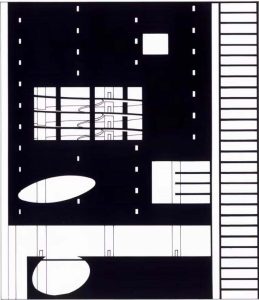
Traditional libraries are usually organized into clear spatial hierarchies: reading rooms, archives, controlled lighting, and carefully ordered collections. Koolhaas deliberately overturns this model. In Très Grande Bibliothèque, books and information are imagined as a dense solid mass, while public spaces such as auditoriums, reading areas, exhibition halls, and gathering spaces are carved out as large interior voids.[1]
This reversal fundamentally changes how users experience the building. Rather than moving between shelves and corridors, visitors occupy open civic spaces carved out of the mass of stored knowledge. The void becomes the project’s architectural focus, while information remains invisibly embedded within the form. Through this strategy, Koolhaas transforms the library from a static archive into a dynamic public environment.[2]
Relationship with Neo-Rationalism
The project also reveals Koolhaas’s complex relationship with Neo-Rationalist architecture. At first glance, the building appears as a simple, controlled geometric volume, recalling the formal clarity of architects such as Aldo Rossi and Oswald Mathias Ungers.[3]
Yet beneath this apparently rational exterior, Koolhaas introduces irregular voids and unexpected spatial conditions that destabilize the form’s purity. Instead of reinforcing permanence and order, the project exposes tension, ambiguity, and fragmentation. In this way, Très Grande Bibliothèque critiques the limitations of rigid typological thinking while still engaging with its formal language.[2]
Public Space and Urban Experience
Although conceived as a library, Très Grande Bibliothèque operates equally as an urban and social environment. Koolhaas treats the building less as an isolated cultural monument and more as a civic condenser capable of absorbing different forms of public activity.[1] Exhibition spaces, auditoriums, circulation zones, and collective gathering areas are integrated directly into the architectural composition, allowing public life to shape the building’s experience.
Rather than separating intellectual activity from everyday urban experience, the project brings them together within a single monumental structure. The library becomes a place of interaction and movement rather than silence and isolation.[2]
Bigness and Social Condensation
The project strongly reflects Koolhaas’s later ideas about “Bigness,” in which architecture gains autonomy through scale and internal complexity. Très Grande Bibliothèque behaves almost like a self-contained city, operating according to its own spatial logic rather than responding directly to the surrounding urban fabric.[3]
Its massive cubic form establishes a strong visual identity, yet the interior remains fluid and unpredictable. Koolhaas uses scale not only as a formal gesture but also to intensify social interaction. The building becomes a framework capable of accommodating cultural exchange, public gathering, learning, and collective experience simultaneously.[1]
Conclusion
Très Grande Bibliothèque remains one of OMA’s clearest explorations of architecture’s relationship with information, public space, and typology. By combining a simple exterior form with complex interior spatial relationships, Koolhaas demonstrates how architecture can move beyond rigid institutional models while still maintaining formal clarity.[2]
More than three decades later, the project remains relevant because it anticipates many contemporary questions about media, collective space, and the evolving role of public institutions in the city.[3]
References
[1] Rem Koolhaas, Bruce Mau, Jennifer Sigler, Hans Werlemann, and Office For Metropolitan Architecture. 1998. Small, Medium, Large, Extra-Large : Office for Metropolitan Architecture, Rem Koolhaas, and Bruce Mau. New York, N.Y.: Monacelli Press.
[2] OMA Rem Koolhaas 1987 1998. 2005. Madrid: El Croquis.
[3] José Rafael Moneo, and Harvard. 2004. Theoretical Anxiety and Design Strategies in the Work of Eight Contemporary Architects. Cambridge, Mass.: Mit Press.