
Introduction
Architectural phenomenology argues that buildings should not be understood merely as visual objects or technical systems. Instead, architecture gains meaning through lived experience, memory, atmosphere, and the relationship between people and place.[1] Against the universal logic of modernism, phenomenological theory emphasizes sensory perception and the emotional depth embedded within architectural space.
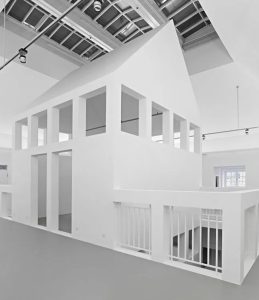
This theoretical position becomes especially visible in the work of Oswald Mathias Ungers. In the German Architecture Museum in Frankfurt, Ungers transforms a nineteenth-century villa by inserting an abstract white “house within a house” into the existing historical structure.[2] Rather than preserving history through imitation or nostalgia, the project establishes a direct spatial dialogue between historical memory and timeless geometric form.
Phenomenology and the Return to Experience
Architectural phenomenology emerged partly as a critique of modernism’s increasing dependence on abstraction, standardization, and technological rationality.[1] While modern architecture often pursued efficiency and universality, phenomenological thinkers argued that architecture should reconnect with bodily perception, material presence, and human experience.
This shift did not reject modernity entirely. Instead, it questioned whether architecture had become disconnected from the emotional and existential dimensions of everyday life. Phenomenology, therefore, repositioned architecture as something experienced physically through light, texture, movement, sound, and atmosphere rather than understood only through drawings or visual appearance.[1]
Ungers’s museum can be read directly within this discourse. Although his architecture appears rational and geometrically controlled, the project ultimately depends on experiential perception rather than formal symbolism alone.
Primitive Form and Historical Memory
The central gesture of the museum is remarkably simple: Ungers inserts a pure white archetypal house inside the historical villa.[2] This intervention creates a layered spatial condition in which two architectural realities coexist.
The original villa preserves the historical and cultural memory of the site through its masonry shell, proportions, and urban presence. The inserted white volume, however, strips architecture down to its most elementary condition. Devoid of ornament and historical decoration, it represents architecture in an almost primordial state.
Rather than competing with history, the abstraction intensifies awareness of it. Visitors continuously perceive the tension between the old and the new, the heavy historical envelope and the silent geometric insertion. Through this contrast, Ungers avoids literal restoration while still preserving the identity and atmosphere of the original structure.[3]
The project, therefore, demonstrates that historical continuity does not necessarily depend on stylistic imitation. Memory can also be sustained through spatial relationships, perception, and bodily awareness.
Light, Space, and Sensory Experience
The museum’s phenomenological power becomes most apparent through its handling of light and movement. The white interior surfaces reflect natural
light softly across the inserted volume, creating an atmosphere that feels detached from ordinary time.[2] Shadows gradually move across the geometric surfaces, making visitors more aware of depth, scale, and spatial proportion.Circulation through the building is equally important. Openings strategically frame fragments of the historical villa, constantly reminding visitors that the abstract white house exists inside an older architectural body. Rather than experiencing the building as a sequence of isolated rooms, visitors become aware of overlapping layers of history and perception.
This spatial ambiguity produces a heightened sense of awareness. The museum feels simultaneously familiar and strange, historical and abstract. Ungers transforms architecture into an experiential condition in which meaning emerges gradually through movement and sensory perception rather than through immediate visual consumption.
Between Rationalism and Phenomenology
Ungers is often associated with Neorationalism because of his use of grids, clear geometry, and formal order.[3] However, the German Architecture Museum reveals that his work cannot be reduced to rational formalism alone.
Beneath the project’s strict geometry lies a deeply phenomenological intention. The inserted house is not important simply because of its shape, but because of the experience it creates. The calm proportions, controlled light, and spatial silence encourage reflection and bodily awareness.
This balance between rational clarity and sensory depth is what gives the project its enduring significance. Ungers demonstrates that minimalist architecture can still convey emotional intensity and existential meaning without resorting to spectacle or excessive formal complexity.
Conclusion
The German Architecture Museum remains one of the clearest examples of how phenomenological ideas can be translated into architectural form. By inserting a primitive geometric volume into a historical villa, Oswald Mathias Ungers creates a powerful dialogue between abstraction and memory, history and timelessness.
More importantly, the project demonstrates that architecture does not communicate meaning only through symbolism or representation. Meaning emerges through spatial experience itself.[1] By carefully orchestrating light, movement, proportion, and historical contrast, Ungers transforms the museum into an architectural exploration of perception, memory, and the enduring spirit of place.
References
[1] Otero-Pailos, Jorge. “Architectural Phenomenology and the Rise of the Postmodern.” In The SAGE Handbook of Architectural Theory, edited by C. Greig Crysler, Stephen Cairns, and Hilde Heynen, 136-151. London: SAGE Publications, 2012.
[2] Team, ArchEyes. 2024. “The German Architecture Museum in Frankfurt by Oswald Mathias Ungers.” ArchEyes. September 4, 2024. https://archeyes.com/the-german-architecture-museum-in-frankfurt-by-oswald-mathias-ungers/
[3] Moneo, Rafael. Theoretical Anxiety and Design Strategies in the Work of Eight Contemporary Architects. Cambridge, MA: MIT Press, 2004.